
Hancock County Criminal Court Cases
Hancock Circuit Court, part of the 38th Judicial Circuit, hears felony cases after indictment and the major proceedings that follow. Hancock District Court, in the 38th Judicial District, handles misdemeanors, violations, traffic matters, and the first stages of many felony cases. Both sit at the same Judicial Center in Hawesville. That shared address does not make the records the same. A person charged with a felony may have a District Court preliminary file and then a separate Circuit Court case after the grand jury returns an indictment.
The Kentucky Court of Justice Hancock County page identifies the Office of Circuit Court Clerk as custodian for both courts. Neither Lewisport nor Hawesville has a municipal court, so city arrests that lead to charges also flow into these county-level court files. Appeals move to Kentucky’s appellate courts, while federal crimes are filed separately in the U.S. District Court for the Western District of Kentucky.
Search Both Hancock Criminal Courts
Searching only one Hancock County court is the easiest way to miss part of a Hancock County criminal case. District case categories can include “M” for criminal misdemeanor matters and “F” for felony preliminary proceedings. A felony that advances after indictment receives a Hancock County Circuit Court “CR” file. The two numbers can trace different stages of one prosecution, not two convictions.
| Hancock court | Criminal work | Record clue |
|---|---|---|
| District Court | Misdemeanors, violations, traffic, and felony preliminary proceedings | Check M and F categories when the original charge level is uncertain |
| Circuit Court | Felonies after indictment and major felony proceedings | Check CR files for the indictment, plea or verdict, judgment, and sentence |
| Appellate courts | Appeals from trial-court rulings | Use separate statewide appellate resources after locating the trial case |
Case numbers commonly encode the year, category, and a sequence number. A category helps route the search, but it does not reveal guilt or the final result. The docket and judgment control that answer.
Searching Hancock County Case Records
The clerk’s counter and phone lines are the best starting points for a local Hancock County case file. A statewide CourtNet report can help locate Kentucky court activity, but it is a report product rather than the signed Hancock County file. Use the smallest set of accurate identifiers, then ask for specific Hancock County records instead of an undefined background check.
- Call or visit the Hancock Circuit Court Clerk and ask staff to search both District and Circuit criminal categories.
- Give the full legal name, an approximate filing year, date of birth when appropriate, and the case number if known.
- Request the docket or register and final judgment first. These show the filed charges, events, outcome, and current status.
- Add the complaint or indictment, bond order, public motions, plea or verdict, and sentencing order needed to understand the case.
- If the file has moved, obtain its records-facility locator details from the clerk and confirm copy or certification costs before ordering.
| Field label | Type | Status | How it helps |
|---|---|---|---|
| Full legal name | Text | Required for name search | List prior names separately |
| Date of birth | Date | Strongly helpful | Separates common-name matches |
| Case number | Text | Optional | Uses the year-category-sequence format |
| County | Choice or text | Required locally | Select Hancock |
| Court or division | Choice | Optional | Choose Circuit or District, or ask for both |
| Filing range | Date range | Optional | Helps with older and archived files |
| Record type | Choice | Required to order | Specify docket, plain copy, certified copy, or AOC report |
Hancock Criminal Clerk Counter
Michael T. Boling’s clerk office is the local record starting point. The Hancock County Judicial Center is at 310 Hawesville School Drive, P.O. Box 250, Hawesville, KY 42348-0250. The clerk’s main numbers are 270-927-8144 and 270-927-8145, with fax 270-927-8629. Hours are Monday through Friday, 8 a.m. to 4 p.m. Appointments are available by request, and the official page also directs people to call or visit for case records.
Office of Circuit Court Clerk
310 Hawesville School Drive
P.O. Box 250
Hawesville, KY 42348-0250
270-927-8144 or 270-927-8145
Monday through Friday, 8 a.m. to 4 p.m.
Published Hancock County payment options include cash, money order, certified check, and a personal check drawn on a local bank. Kentucky ePay covers eligible court obligations. Those options do not establish a copy price, so ask the Hancock County clerk for the current plain-copy and certified-copy cost before sending funds.
Inside a Hancock County Case File
A Hancock County court case file records what prosecutors filed and what the judge decided. It is more useful than an arrest entry when the question is whether a charge changed, ended in dismissal, reached a plea or trial, or produced a sentence. Public displays may list an event without exposing the signed document, so a clerk copy can be essential.
| Case number and court | Identifies Hancock County, Circuit or District Court, filing year, category, and sequence. |
|---|---|
| Charging document | The complaint or indictment states the charges actually filed and their Kentucky statute citations. |
| Docket entries | A dated index of filings, hearings, motions, orders, and other public case events. |
| Bond and hearings | Shows public bond action, scheduled proceedings, and recorded court appearances. |
| Disposition and judgment | Records dismissal, acquittal, plea, verdict, amended charge, diversion outcome, or other final action. |
| Sentence and costs | Shows the court’s sentence, probation terms in the order, fines, costs, and related entries. |
| Appearances and documents | Lists attorneys and descriptions of public documents, though a PDF may require clerk access. |
Hancock CourtNet Report Limits
The Kentucky eCourt guest login shows the entry point captured for Hancock County criminal court research. Access and available documents depend on the user’s account type.
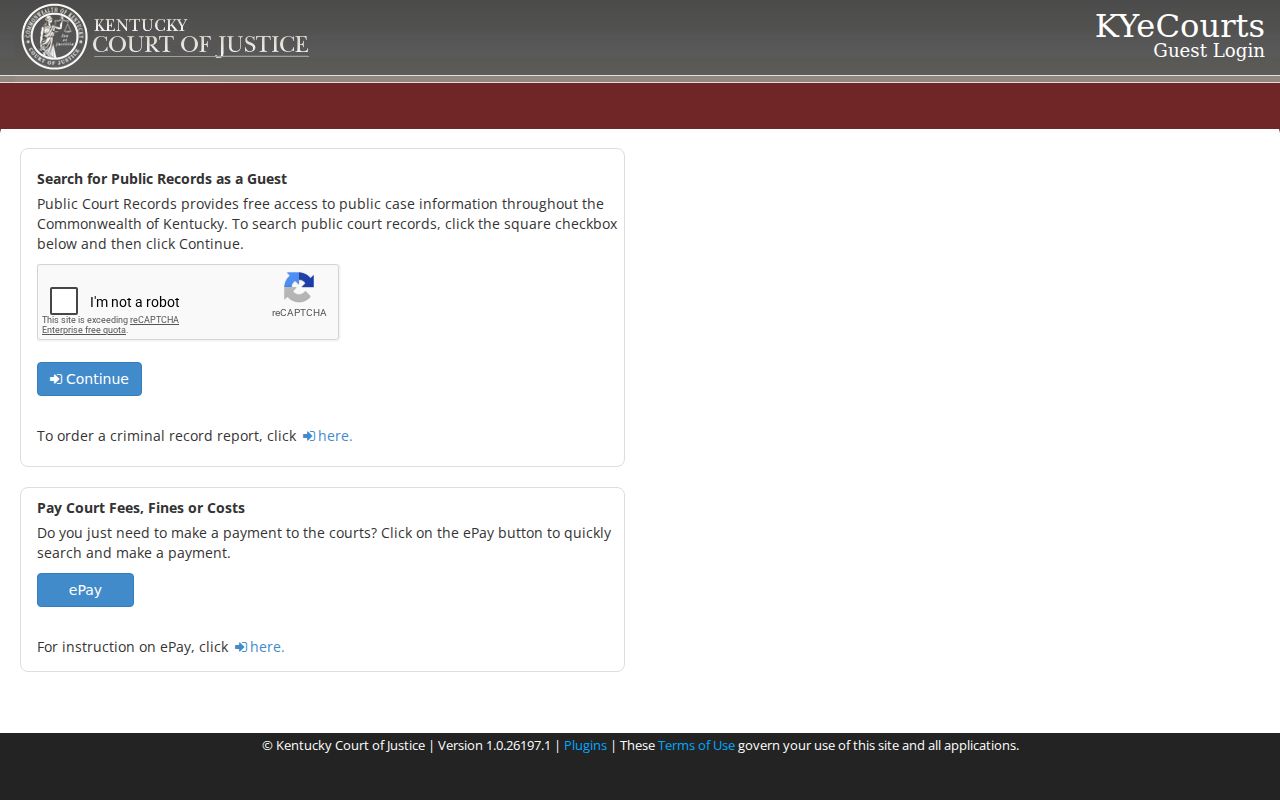
The screen is a useful reminder that an electronic case event and the signed Hancock County document are not always the same thing. CourtNet criminal-record reports broaden a search across Kentucky courts, while the Hancock County clerk file provides the pleadings, orders, and certified copies tied to the actual case.
A CourtNet report can exclude juvenile, confidential, sealed, and expunged matters. It also does not contain federal records or every police narrative. If a known Hancock case does not appear, check both trial-court levels, verify name and date-of-birth data, and ask whether the file has been archived.
How a Criminal Case Moves
A Hancock County felony often begins in District Court with an initial appearance, bond review, complaint, and preliminary step. If the grand jury returns an indictment, the prosecution advances in Circuit Court. A misdemeanor generally stays in District Court. No fixed local duration was verified, so filing and hearing dates must be read from the individual docket.
Case flow: Charges Filed › Arraignment › Pretrial › Plea or Trial › Disposition › Sentencing
After a Hancock County judgment, an appeal or post-conviction filing can add more entries. The arrest allegation should never be used as a shortcut for the outcome. A dismissal, acquittal, amended charge, guilty plea, verdict, or sentence is established by the Hancock County docket and final order.
Read Hancock Court Terms Correctly
Several short terms can change the meaning of a Hancock County criminal docket. “Commonwealth” identifies the prosecution in a Kentucky criminal case. An indictment is a grand jury’s formal felony accusation, but it is not a conviction. A “true bill” means an indictment was returned, while a “no bill” means the grand jury did not return one.
- Arraignment
- The hearing where charges are formally presented and a plea is entered.
- Disposition
- The outcome of a charge or case, such as dismissal, acquittal, plea, or verdict.
- Nolle prosequi
- The prosecutor’s formal decision not to continue a charge at that time.
- Capias
- A court command to take a person into custody, often after a failure to comply.
- Concurrent
- Sentences served at the same time, unlike consecutive sentences served one after another.
Note: A docket code is a routing clue, not proof of the charge’s final outcome in court.
Hancock Criminal Court Calendars
The local schedule helps a reader place docket dates in context. Hancock District Court lists the first and third Tuesday, with criminal matters at 9:30 a.m. Circuit Court lists criminal motion day on the fourth Friday at 10 a.m. These are calendar patterns, not promises that a specific case will be heard on a given date. Confirm the case’s current setting with the clerk before relying on a published schedule.
The 38th Judicial Circuit roster names Timothy R. Coleman as chief circuit judge and Benjamin D. McKown as family court judge. District Judges Gregory Vincent and Daniel Boling serve the 38th Judicial District. Family and confidential calendars are separate from public adult criminal dockets, and protected proceedings should not be treated as open Hancock County criminal court cases.
Case Record Access & Restrictions
Kentucky court records are administered by the judicial branch and local circuit clerks under Court of Justice access rules. The Kentucky Open Records Act governs many executive-branch records, but it is not a substitute for the courts’ own record process. Public Hancock County case material can still be limited by rules protecting juveniles, sealed or expunged cases, victims and minors, financial-account data, Social Security numbers, and confidential proceedings.
Access point: Ask the Hancock clerk whether a missing record is confidential, expunged, filed under another court category, transferred to storage, or destroyed under a retention schedule.
For older files, the Kentucky Court of Justice says the circuit clerk can identify the records facility and provide locator information. Some records may no longer exist under retention rules. If the issue began with an arrest, the police report remains with the arresting agency, while the filed charge and outcome belong in the Hancock County arrest and court record trail. Each custodian should be asked only for the record it created.